Laryngectomy Support
BAHNON Council were deeply saddened to hear about the closure of the National Association of Laryngectomee Clubs (NALC) Charity earlier this year. First set up in 1975, NALC were a leading figure in promoting rehabilitation of laryngectomees after surgery as well as promoting public understanding of the needs of laryngectomees, their carers and family. Given the wealth of information contained on their website, this will continue to be accessible. BAHNON would like to thank all those involved in the work of NALC over the years for their dedication and service to this incredible patient group.
We are however, pleased to see that Life After Lary (Registered Charity 1215969) are filling the gap left by NALC, with dedicated support for all Laryngectomees and their families.
About Life After Lary
Life After Lary was born from a simple but powerful truth, that life after a laryngectomy can feel frightening, isolating, and overwhelming. When you leave hospital, the world feels different. Your body feels different. Your voice is different, if at all. And for many people, that moment of stepping back into everyday life is the hardest part of the entire journey. Our charity exists because no one should face that moment alone.
Life After Lary is a patient led charity supporting people who have undergone a laryngectomy and are living with a permanent stoma. The organisation was founded by people with lived experience who recognised that while medical care around surgery is excellent, many patients struggle significantly once they return home and begin adjusting to life after surgery. Life After Lary exists to ensure that no one faces life after a laryngectomy alone. Our focus is on long term support, peer support, practical help, community, and improving quality of life for patients and their families.
Our Collaborative Partnerships
A core strength of Life After Lary is the exceptional working relationships we have built across the UK. We collaborate closely with many hospitals, speech therapists, and clinicians, ensuring that peer support sits alongside clinical care. We are proud to work with national organisations including the Royal College of Speech and Language Therapy, Macmillan, BAHNON (British Association of Head and Neck Oncology Nurses), ATOS Medical, Severn Health, SheffMed, SLO The throat cancer foundation, Radiotherapy UK The Royal Marsden, North Thames Genomic medicine, Cancer research UK and many others.
These partnerships help us reach more patients, and ensure that people receive consistent, compassionate, and informed support wherever they live. Our collaborative approach is simple: we work with, not instead of, clinical teams, bringing lived experience into the heart of patient support.
Our Structure, Volunteers and National Reach
Life After Lary is entirely volunteer led. We have no employees and no one within the organisation is paid a wage or a fee. The charity is run completely by volunteers who give their time freely because they care deeply about supporting people living with a laryngectomy. Our trustees and volunteers include people who have had a laryngectomy themselves, family members and loved ones of laryngectomy patients, and people who have become involved because they believe in the work we are doing and want to support the community. We operate as a national organisation, with volunteers supporting patients, families, and groups across the UK. Support is provided through hospital visits, local meet ups, online support, telephone support, and national networking between groups and patients. Life After Lary uses a mixture of modern
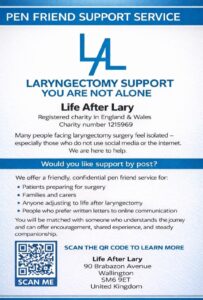
technology and traditional methods to connect with and support people across the UK. We communicate through social media, online groups, Zoom meetings and digital resources, while also using newsletters, leaflets, posters, and face to face meetings. Most importantly, we still believe in personal contact, whether that isa hospital visit, a local meet up, or simply picking up the phone and speaking to someone. We also offer a pen friend service.
One to one, patient to patient.
The organisation is built on goodwill, lived experience, compassion, and a shared desire to ensure that other people do not feel alone before or after surgery. The passion and commitment of our 22 volunteers is what drives the organisation forward, and every pound of funding received goes directly towards supporting patients, building support networks, and developing resources, rather than staffing or organisational overheads. This volunteer led structure allows us to remain very close to the community we support and ensures that everything we do is focused on improving the lives of people living with a laryngectomy and their families.
What We Do
Life After Lary provides support in several key areas:
Peer support from people who have had a laryngectomy
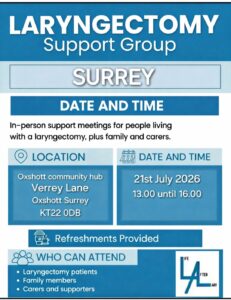
Local meet ups and support groups
Hospital visits to new patients
Telephone and online support plus pen pals
Practical advice on living with a stoma
Support for families and carers
Care packages for patients after surgery
Community building and reducing isolation
Awareness raising
Working with clinicians and other organisations
Our support is based on lived experience. Patients often say that the most helpful conversations they have are with someone who has already been through the same surgery and understands the reality of day to day life afterwards.
Why Our Work Matters
Many laryngectomy patients report that the period after leaving hospital is the most difficult time. People often experience isolation, loss of confidence, difficulty communicating, anxiety, depression, and practical challenges around everyday life. Clinical care is essential, but so is peer support and community. Speaking to someone who has been through the same experience can be life changing for a new patient.
We regularly support people who:
Have not left the house for months after surgery due to lack of confidence
Are struggling to communicate and feel isolated
Do not know how to manage day to day life with a stoma
Need reassurance that life can return to normal
Through peer support, visits, phone calls, and meet ups, pen pals and 24/7 text support, we help people rebuild confidence, independence, and social connection.
Our Mission
Our mission is simple: To ensure that no one faces life after a laryngectomy alone, and that every patient has access to ongoing peer support, practical help, and a supportive community.
We aim to:
Reduce isolation
Improve mental wellbeing
Build confidence and independence
Support families and carers
Create a national support network
Work alongside existing groups and organisations
Ensure long term support for future patients
Our Values
Life After Lary is built on the following principles:
Peer led support
Kindness and understanding
Community and connection
Practical help and advice
Inclusion and accessibility
Collaboration, not competition
Supporting people for life, not just during treatment
We believe that lived experience support is essential and should sit alongside clinical support. Our aim is to help connect groups, support patients nationally, and ensure that peer support and community remain at the heart of support for laryngectomy patients across the UK.
Impact and Growth
Life After Lary has grown quickly because there is a clear need for ongoing support after surgery and throughout life.
Over the past year we have:
Supported patients through peer support calls and messages
Visited patients in hospital
Helped establish and support local meet ups
Sent care packages to new patients
Built an online support network
Worked with clinicians and hospitals
Increased awareness of life after laryngectomy
Built a growing national community
We expect the number of people we support to continue to grow as awareness
Increases and more hospitals and patients become aware of the support available.
Future Plans and Growth
Over the next few years, our aims are to:
Expand peer support across more hospitals
Support more local support groups and meetups
Provide care packages for more new patients
Develop information and resources for patients and families
Build a national network connecting groups and patients
Support volunteers and peer supporters
Work more closely with clinicians and hospitals
Ensure long term sustainability of support for patients
Our aim is to build a sustainable national support network that will continue supporting patients and families for many years to come.
Use of Funding.
We are 22 volunteers and paid no wages or fees
If any funding becomes available, it is used directly to support patients and expand our support network. This includes:
Care packages for new patients
Supporting local support groups and meetups
Travel costs for hospital visits and peer support
Information and printed materials
Website and online support resources
Volunteer training and support
Supporting collaboration between groups
Building a sustainable national support network
Supporting patients and families across the UK
Any funding would be used directly to support people living with a laryngectomy and to strengthen the support available to future patients.
Summary
We believe strongly that people who undergo a laryngectomy need support not just during surgery and treatment, but for the rest of their lives afterwards. Life After Lary focuses on exactly that, life after a laryngectomy, the day‑to‑day reality of living with a stoma, rebuilding confidence, reducing isolation, and helping people and their families adjust to a new way of living.
We are a patient‑led, volunteer‑run national organisation made up of people who have had a laryngectomy themselves, family members, loved ones, and people who care deeply about this community. Everything we do is driven by lived experience, compassion, and a commitment to ensuring that no one feels alone after surgery. Because we are entirely volunteer led and have no paid staff, every pound of funding goes directly into supporting patients, building networks, developing resources, and reaching more people across the UK.
Life After Lary is about people, about families, about community, and about life after a laryngectomy. And that is why we are here today, because we would like to work alongside you to strengthen the support available within your hospital.
We know how busy clinical teams are, and how much pressure nurses carry when caring for patients who are adjusting to a new way of breathing, speaking, and living. Our aim is not to add to your workload, but to stand beside you. We would like to establish a regular support group within your hospital, giving your patients a safe, welcoming space to meet others who truly understand what they are going through. These groups help rebuild confidence, reduce isolation, and provide reassurance for families who are often just as affected by the surgery as the patient.
Alongside this, we would like to offer a quarterly Life After Lary stand in your hospital. These stands are not for fundraising, they exist purely to support your patients. They allow us to meet people early, answer questions, provide practical advice, and offer peer support from the very beginning of their journey. Many hospitals tell us how valuable these stands are because they give patients immediate access to lived‑experience support, while giving nurses an additional layer of help without taking time away from clinical care.
We are committed to continuing and growing this support for many years to come, and we would make very careful and meaningful use of any support or partnership that helps us reach more people living with a laryngectomy across the UK.
Jon Organ / Ian Phillipson
Mission Statement
Life after laryngectomy is a journey of profound change, physically, emotionally, and socially.
Our mission is simple: to make sure no one walks that journey alone. We walk beside every person with compassion, community, and practical support, so that isolation turns into belonging and fear into strength.
At the heart of everything we do is an unshakable belief: no Lary should ever be alone.
Through HEAL, we bring our mission to life:
H – Hope & Healing
Reminding every survivor that their life, though changed, can still be full of meaning, creativity, and purpose.
E – Empowerment
Giving people the confidence, tools, and encouragement to take control of their recovery, their voice, and their future.
A – Awareness
Sharing clear information about recovery, speech options, managing complications, and mental health, while raising public awareness to break down stigma and misunderstanding.
L – Life after Laryngectomy
Building a safe, supportive community where experiences are shared, strength is found, and every person is celebrated for who they are, not what they have lost.
We believe scars are not signs of weakness, but of resilience.
We believe that communication is more than a voice — it is presence, expression, and connection.
And we believe that with the right support, every person can discover strength in their new normal and live fully, with courage and hope.
This is more than a charity. It is a lifeline, a family, and a movement. Together, we HEAL.